

A successful pilot build is an important milestone. But producing a small batch of working medical devices does not automatically establish that the same product can be manufactured consistently at commercial volumes.
As demand grows, informal assembly methods, incomplete documentation, component shortages, and testing bottlenecks can become production problems. What worked with a small team of engineers may become difficult to repeat across more operators, shifts, and production lots.
Scaling medical device manufacturing requires a controlled transition from pilot builds to repeatable production with documented assembly processes, qualified suppliers, appropriate validation, consistent testing, and clear quality responsibilities.
For medical device OEMs, the goal is dependable delivery of finished devices that meet established requirements.
- What changes between pilot builds and commercial production.
- Which manufacturing gaps to address before increasing volume.
- How to evaluate a contract manufacturer’s readiness to support your growth.
- What to prepare for a productive manufacturing discussion.
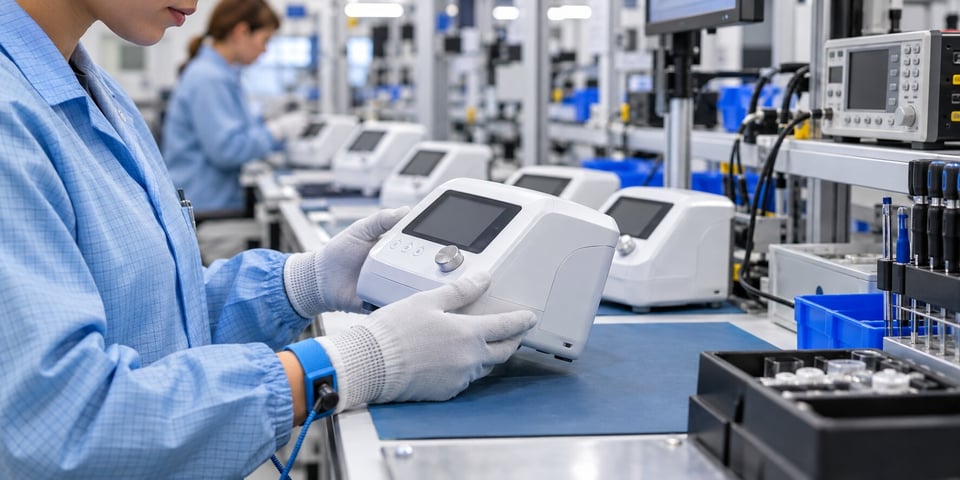
Pilot builds help a team evaluate how a device can be assembled, identify manufacturing issues, and refine production methods. Commercial production requires those methods to operate consistently within an established quality system.
The distinction is less about a specific number of units and more about manufacturing readiness.
| Manufacturing area | Pilot-build focus | Commercial-production requirement |
|---|---|---|
| Assembly | Identify and refine the build method | Execute controlled, repeatable instructions |
| Materials | Obtain parts for initial builds | Maintain qualified sources and reliable availability |
| Testing | Develop and evaluate test methods | Apply controlled methods and acceptance criteria |
| Staffing | Resolve issues with close engineering support | Train operators to perform defined tasks consistently |
| Documentation | Capture lessons and necessary changes | Maintain approved records and revision control |
| Capacity | Complete the initial build | Meet demand at an achievable production rate |
Pilot builds should reveal what needs improvement. Commercial readiness depends on resolving those findings before they become recurring production disruptions.
Early builds often depend on people who know the device exceptionally well. They recognize an incorrect fit, understand an unwritten assembly sequence, or know when an adjustment is necessary.
That knowledge needs to become part of the manufacturing process.
A production transfer package should address the following: (if applicable)
For complete medical device assembly, the interfaces between subsystems deserve particular attention. A device may contain individually acceptable parts yet fail because of routing, alignment, connection, or configuration errors during final integration.
Ask a potential partner: How will you identify and resolve gaps in our manufacturing documentation before the production ramp?
A pilot run provides more useful information when it reflects the planned commercial manufacturing environment.
Where practical, that means using the intended materials, equipment, fixtures, instructions, test methods, and trained personnel. Differences between pilot and commercial conditions should be understood and assessed.
For example, a device assembled successfully by a development engineer may still present difficulties for a production operator following the written instructions. A test procedure that works for a few devices may become a bottleneck when daily output increases.
Track findings such as:
A completed pilot run should produce more than finished devices. It should provide evidence for deciding what is ready, what needs correction, and what must be reassessed.
A scalable process needs clear methods for determining whether devices meet requirements and whether manufacturing processes perform consistently.
These activities serve different purposes:
Product testing and inspection evaluate whether specified requirements have been met.
Process validation, where required, establishes documented evidence that a process can consistently achieve its intended results. Final inspection alone may not adequately establish the acceptability of every process outcome.
The OEM and contract manufacturer should agree on applicable validation activities, responsibilities, acceptance criteria, and approval requirements. Depending on the process, this may include installation, operational, and performance qualification commonly called IQ, OQ, and PQ.
For finished electronic or electromechanical devices, planning should also address functional testing, configuration verification, test equipment suitability, and how results will be recorded.
FDA’s Quality Management System Regulation (QMSR) incorporates ISO 13485:2016 by reference into the U.S. device quality system framework. Manufacturing plans should reflect current applicable requirements. See FDA’s QMSR overview.
Ask a potential partner: Which processes require validation, who owns each activity, and what evidence is needed before production release?
Parts availability for one pilot batch does not establish supply-chain readiness for ongoing production.
Before committing to a commercial schedule, review:
An available substitute is not automatically an acceptable substitute. Component changes may require engineering review, testing, validation, or regulatory assessment before implementation.
OEMs should also distinguish expected demand from committed demand. A shared forecast, purchasing plan, and escalation process help the manufacturing team prepare without creating unnecessary inventory exposure.
As volume increases, the ability to reconstruct how a device was manufactured becomes more valuable.
Depending on product requirements, manufacturing records may need to connect a finished device or production lot with relevant materials, assembly activities, configuration information, inspections, and test results.
Change control is equally important. A revised component, updated firmware version, new fixture, or modified assembly instruction can affect production consistency.
Before scaling, establish:
The objective is to keep the approved product configuration aligned with what is purchased, built, tested, and released.
Adding operators or equipment does not necessarily remove the constraint limiting output.
A production ramp should consider the entire flow, including assembly, testing, inspection, packaging, and release. Increasing assembly capacity provides limited benefit if functional testing cannot keep pace.
Agree on readiness criteria before raising production targets. Useful measures include:
Targets should reflect the device, process risks, and customer requirements. There is no single production volume or yield percentage that establishes commercial readiness for every medical device.
Involve a medical device contract manufacturer before the pilot-to-commercial transition is fully defined. Early collaboration can help identify documentation gaps, assembly challenges, supply risks, and test-capacity needs while there is still time to address them.
If your pilot builds are already complete, a structured readiness review can establish what remains before the production ramp.
Sanbor Medical’s article on the role of contract manufacturers in medical device new product introduction explores how manufacturing involvement supports this transition.
Available capacity is only one part of the decision. Ask prospective partners how they will manage the transition to repeatable finished-device production.
Useful questions include:
Look for specific explanations of the work, responsibilities, and decision points involved.
Sanbor Medical provides contract manufacturing exclusively for medical devices, supported by more than 30 years of production experience and a global manufacturing footprint.
For OEMs preparing to scale complete device assembly, a manufacturing discussion can help clarify the path from the current build process to commercial production.
Moving beyond pilot builds? Talk with Sanbor Medical about your production requirements. Share your device overview, current build stage, expected annual volume, and target timeline to start a focused conversation about your program.
Scaling requires transferring the device into controlled production processes, preparing suppliers, defining testing and validation activities, training personnel, and increasing capacity against agreed quality and delivery criteria. Pilot-build findings should inform the production ramp.
There is no universal pilot-build quantity. The appropriate number depends on the build’s purpose, device complexity, process risks, and any applicable verification or validation requirements. Define what the build must demonstrate before deciding its size.
Common causes include incomplete documentation, unresolved assembly issues, long-lead components, inadequate test capacity, and late changes. A readiness review helps identify these gaps before the OEM commits to a production schedule.
Start with a device overview, current development or production stage, expected volumes, target timeline, and known manufacturing challenges. Available drawings, the bill of materials, assembly requirements, and testing specifications support a more detailed evaluation.
