

A medical device can contain approved components, pass in-process inspections, and still experience problems after everything is assembled into the finished product.
That is why medical device functional testing is an important part of complete-device manufacturing.
Functional testing verifies that the finished device performs according to the OEM's defined requirements after its electronics, mechanical components, sensors, firmware, controls, and other subsystems have been integrated.
For medical device OEMs, testing should not be viewed simply as the final step before shipment. It is part of the overall manufacturing process used to confirm quality, identify production issues, and support traceability.
In this article, we'll cover:
- What medical device functional testing involves
- Why component inspection alone may not be enough
- How finished-device testing supports quality
- Why documentation and traceability matter
- What OEMs should expect from a contract manufacturing partner
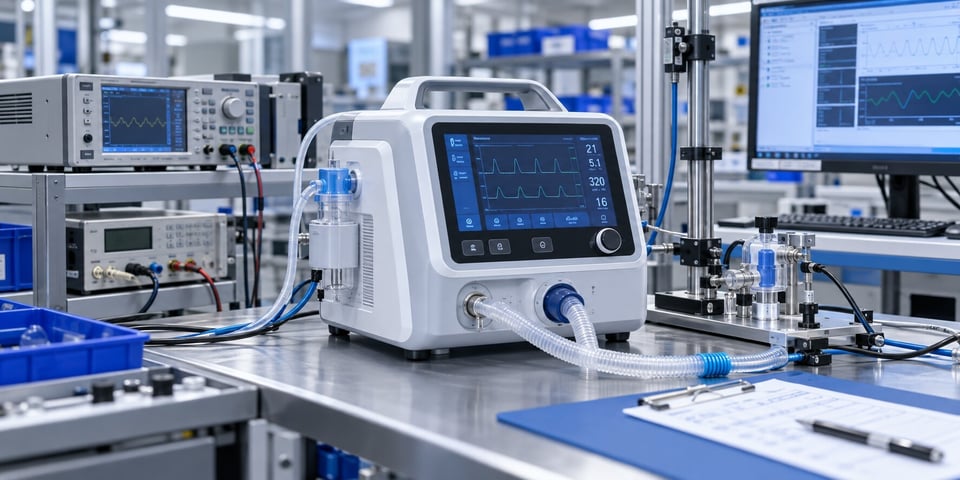
Medical device functional testing evaluates whether a finished or substantially completed device performs the functions defined by the OEM.
Depending on the product, that may include:
The exact requirements depend on the device, its intended function, and the OEM's approved manufacturing specifications.
The core question is simple:
Does the completed device function the way it is supposed to?
This is particularly important in medical device box build assembly, where multiple subsystems and components come together in one finished product.
Quality starts long before final testing.
Incoming materials can be inspected. Subassemblies can be tested. Manufacturing processes can have defined controls and acceptance criteria.
But those activities do not necessarily confirm that the integrated device will operate correctly.
A product containing electronics, sensors, a display, internal wiring, power components, firmware, and mechanical assemblies could still experience problems such as:
These problems may only become visible after the complete system is assembled.
Connected products can add further complexity. Our article on manufacturing connected medical devices discusses considerations such as firmware, connectivity, configuration, and device-level testing in greater detail.
Effective functional testing begins with defined requirements.
The OEM and contract manufacturer should understand what needs to be tested, how each function will be evaluated, and what constitutes a passing result.
A production test plan may define:
Clear acceptance criteria are especially important.
A test should not depend on an operator deciding whether a device simply "appears to work." Where appropriate, results should be based on measurable and repeatable pass/fail requirements.
There is no single functional test that applies to every medical device.
The testing strategy should reflect the functions and risks of the actual product.
Testing may also occur at several points during production.
In-process testing can identify problems before additional labor and materials are added.
Final functional testing verifies that the completed device performs according to the approved production requirements.
Calibration or configuration verification may also be required for devices involving sensors, firmware, serialized settings, or other controlled parameters.
This approach helps manufacturers identify issues at the most appropriate point instead of relying entirely on inspection after the finished device is complete.
Functional testing also creates valuable manufacturing data.
Depending on the product and OEM requirements, test results may be associated with:
This creates a connection between the finished product and its production history:
What was built → how it was configured → what was tested → what result was recorded
That information can be valuable if a problem is identified later.
Our article on how contract manufacturers support post-market medical device quality explains how manufacturing and traceability records can support investigations after devices enter the field.
Test failures can also provide useful feedback before products leave production.
A recurring failure may identify an issue involving:
When failures are documented and investigated, testing becomes more than a final quality gate. It becomes part of the continuous feedback used to improve production.
Medical device testing does not operate independently from the manufacturer's quality system.
The FDA's Quality Management System Regulation (QMSR) incorporates ISO 13485:2016 into the FDA's quality-management framework for medical devices.
Within a controlled manufacturing environment, functional testing works alongside activities such as:
Testing cannot compensate for an uncontrolled production process.
Instead, it provides another level of verification that the manufacturing system is producing devices according to defined requirements.
When evaluating a medical device contract manufacturer, OEMs should consider more than whether a final test station exists.
Key questions include:
Testing should be based on controlled procedures, appropriate equipment, and clear acceptance criteria.
OEMs should understand how test results are recorded and associated with serial numbers, lots, revisions, or other production records.
There should be established processes for controlling failed devices, investigating issues, and identifying recurring manufacturing problems.
For a full box build, testing should work together with sourcing, assembly, inspection, traceability, and quality control rather than functioning as an isolated final step.
Sanbor Medical focuses on full medical device box builds and complete-device manufacturing.
Depending on the OEM's product and production requirements, Sanbor Medical can support:
Sanbor Medical's approach to medical device quality emphasizes building quality into the complete manufacturing process rather than relying on final inspection alone.
The objective is not simply to find defective products before shipment.
It is to establish a controlled manufacturing process capable of consistently producing finished devices—and to use functional testing to verify that the process is delivering the expected result.
Medical device functional testing provides an important link between component quality and finished-device performance.
It verifies that integrated subsystems work together, confirms that the device has been assembled and configured correctly, and creates production data that can support traceability and ongoing quality improvement.
For OEMs, the strongest manufacturing programs combine assembly, inspection, testing, documentation, and quality control into one coordinated process.
If you're evaluating a manufacturing partner for a complete medical device build or considering transferring an existing product, contact Sanbor Medical to discuss your manufacturing and functional testing requirements.
Medical device functional testing verifies that a finished or substantially completed device performs the functions defined by the OEM, such as power-up, sensor response, user-interface operation, connectivity, firmware configuration, calibration, or other device-specific functions.
Individual components can meet their specifications while problems only appear after they are integrated. Finished-device functional testing evaluates how the components and subsystems perform together.
Testing can occur at multiple stages, including in-process verification, subassembly testing, calibration, configuration, and final finished-device testing. The appropriate approach depends on the product and manufacturing requirements.
Depending on the product, test results may be associated with serial numbers, lots, revisions, firmware versions, calibration records, production dates, or other traceability information.
OEMs should look for repeatable testing procedures, controlled equipment and fixtures, clear acceptance criteria, traceable results, defined failure-management processes, and integration of testing into the complete manufacturing program.
